
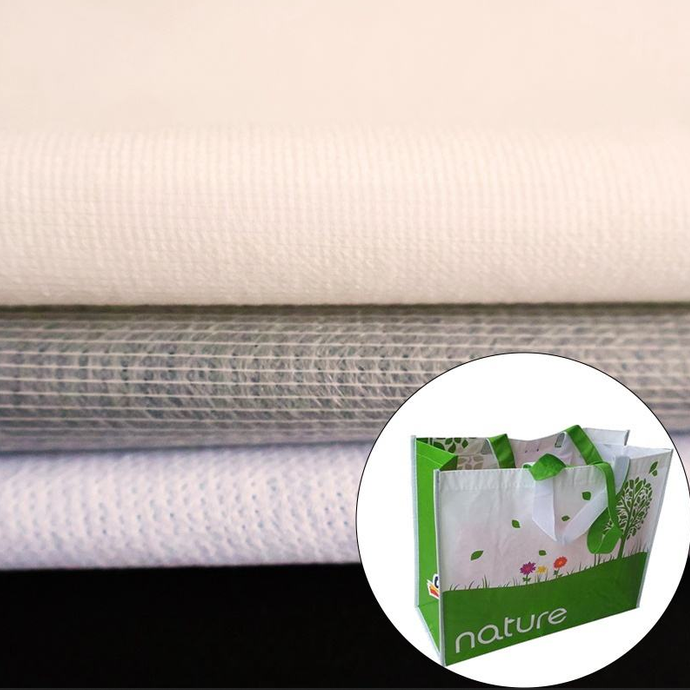
StitchBond Direct manufactures stitchbond RPET nonwoven fabric engineered specifically for reusable shopping bag production. This fabric combines the mechanical strength of stitch-bonding technology with 100% recycled polyester (RPET) made from post-consumer PET bottles — delivering a bag material that is strong, printable, and verifiably sustainable.
Unlike conventional spunbond or thermal-bonded nonwovens, our stitchbond construction mechanically interloops fibers to create a fabric with higher tensile strength and superior tear resistance at the same weight. For shopping bags, this means fewer seam failures, better handle attachment, and a bag that survives real-world grocery loads.
Each standard shopping bag made from our fabric consumes approximately 3 to 5 recycled PET bottles, depending on fabric weight. Available from 65 GSM to 300 GSM, with stitch spacing from 7F to 22F and widths up to 420 cm. All production is GRS certified and OEKO-TEX Standard 100 compliant.
Technical Specifications
| Parameter | Specification |
|---|---|
| Material | 100% recycled polyester (RPET) — post-consumer PET bottle flakes |
| Fabric Construction | Stitchbond (stitch-bonded nonwoven) |
| Basis Weight | 65 GSM – 300 GSM |
| Stitch Spacing | 7F, 9F, 10F, 14F, 18F, 20F, 22F |
| Thickness | 0.3 mm – 1.2 mm |
| Width | Up to 420 cm (custom slitting available) |
| Tensile Strength | 85–110 N/5cm (at 120 GSM, MD/CD) |
| Color | White, black, beige, camel, or custom Pantone matching |
| Lamination | Optional BOPP film lamination for sharper print and water resistance |
| Certifications | GRS (Global Recycled Standard) · OEKO-TEX Standard 100 · EU REACH |
| MOQ | 500 kg (negotiable for trial orders) |
| Production Capacity | 500,000 meters / week |
Why Stitchbond Nonwoven for Shopping Bags?
Stitch-bonding is a mechanical process that interlocks fibers with parallel stitches, creating a fabric structure that outperforms many other nonwoven types in bag applications:
- Higher tensile strength — stitchbond fabric resists tearing at seams and handle attachment points far better than spunbond or thermal-bonded nonwovens at the same GSM.
- Excellent dimensional stability — the fabric holds its shape during cutting, printing, and sewing, reducing waste and rework in bag conversion lines.
- Superior print surface — the smooth, uniform surface accepts heat transfer, screen printing, and BOPP lamination with sharp, vibrant results.
- Breathable yet strong — ideal for reusable bags that need to carry weight without feeling stiff or plastic-like.
Performance Comparison for Bag Materials
| Parameter | Stitchbond RPET Nonwoven | PP Spunbond Nonwoven | Cotton Canvas (10oz) |
|---|---|---|---|
| Typical GSM for bags | 100–130 GSM | 80–120 GSM | 340–370 GSM |
| Tensile strength | 85–110 N/5cm | 18–45 N/5cm | 280–320 N/5cm |
| Max carry load | 3–6 kg (120 GSM) | 3–8 kg | 8–15 kg |
| Print quality | Excellent (heat transfer, screen) | Good (screen, offset) | Good (screen, embroidery) |
| Recycled content | 100% RPET available | Limited | Natural fiber (no recycled content) |
How to Choose the Right GSM for Your Shopping Bag
Fabric weight (GSM) directly determines the bag’s load-bearing capacity, tear resistance, and production cost. Below is our recommended GSM selection guide based on actual field performance data for stitchbond RPET nonwoven:
| Bag Type | Recommended GSM | Max Carry Load | Best For |
|---|---|---|---|
| Lightweight promotional bag | 65–80 GSM | 3–5 kg | Trade show giveaways, single-use events |
| Standard reusable shopping bag | 100–130 GSM | 6–10 kg | Supermarket, grocery, retail |
| Heavy-duty reusable bag | 150–200 GSM | 10–15 kg | Premium retail, brand promotional programs |
| Laminated premium bag | 120–180 GSM + BOPP film | 8–12 kg | High-end brand packaging, corporate gifts |
Important note: For reusable bags expected to survive 50+ carry cycles under real shopping loads, we recommend a minimum of 100 GSM with sewn handle attachment or reinforced heat-sealed construction. At 80 GSM, ultrasonic welding creates a bond zone of roughly 8–10 mm effective width — adequate for promotional giveaways used 5–10 times, but not for a reusable retail bag under sustained grocery loads.
Finishing Options for Bag Production
| Finishing Option | Benefit for Shopping Bags |
|---|---|
| BOPP film lamination | Sharper print resolution, water resistance, stiffer hand feel for premium bags |
| Heat transfer printing | Full-color branding with high adhesion on stitchbond surface |
| Screen printing | Cost-effective for 1–3 color logos at high volumes |
| Custom color matching | Pantone matching for brand-specific fabric colors |
| Anti-bacterial treatment | Optional for food-contact and hygiene-sensitive applications |
| Water-resistant finish | Protects bag contents in outdoor retail environments |
Certifications & Compliance
- GRS (Global Recycled Standard) — transaction certificate available per order, providing verified chain-of-custody documentation for recycled content claims. Recycled content of a specific order is evidenced by a GRS transaction certificate issued by a certification body.
- OEKO-TEX Standard 100 — certified free from harmful substances; suitable for consumer-contact products
- EU REACH — compliant with Regulation (EC) No 1907/2006
- USA RPET Certified (SCS) — available on request for North American market programs
- ISO 14001 — environmental management system certification
Important for brand owners: A GRS certificate on the fabric confirms the fabric’s recycled content. The finished bag’s recycled percentage will differ because handles, lamination film, and thread are counted separately. We can provide a component-level recycled content calculation for your bag construction upon request.
Packaging & Logistics
| Item | Standard |
|---|---|
| Roll length | 1,000–2,000 meters per roll (customizable) |
| Roll core | 3-inch paper core or plastic core |
| Outer wrapping | PE film + woven bag (moisture protection) |
| Container loading | 20–24 rolls per 20′ container (dependent on width/GSM) |
| Lead time | 7–15 days for stock specifications; 15–25 days for custom runs |
| Shipping terms | FOB Shanghai / Ningbo · CIF · DDP available |
Frequently Asked Questions
What is stitchbond RPET nonwoven fabric?
Stitchbond RPET nonwoven fabric is made by mechanically interlooping 100% recycled polyester fibers with a stitching process. This creates a fabric with higher tensile strength and better dimensional stability than many spunbond or thermal-bonded nonwovens, while remaining breathable and flexible — ideal for reusable shopping bags.
What GSM stitchbond RPET should I use for reusable shopping bags?
For standard reusable grocery bags, 100–130 GSM is the industry standard, supporting 6–10 kg loads. For lightweight promotional giveaways, 65–80 GSM is sufficient. For heavy-duty or premium retail bags, 150–200 GSM is recommended. We can provide a GSM recommendation based on your specific bag dimensions and target load.
Can you provide GRS certification for the fabric?
Yes. We supply GRS transaction certificates for each qualifying order. This document confirms the recycled content of the specific fabric shipped and is the standard evidence accepted by EU and North American brand compliance teams. We can also provide OEKO-TEX Standard 100 and USA SCS RPET certificates.
Is stitchbond RPET suitable for heat-sealed (ultrasonic) bag construction?
Yes. Our stitchbond RPET is compatible with both sewn and heat-bonded/ultrasonic construction methods. For ultrasonic welding, we recommend a minimum of 100 GSM with reinforced handle attachment. At lower weights, sewn handles with bartack reinforcement provide better durability.
Can you supply laminated stitchbond RPET fabric for premium bag programs?
Yes. We offer BOPP film lamination in various thicknesses and finishes (gloss, matte). Laminated fabric provides sharper print quality, water resistance, and a stiffer hand feel suitable for high-end retail and corporate gift bags. Lamination typically adds 15–30 GSM to the base fabric weight.
How many recycled bottles are used per square meter of fabric?
For a standard 100 GSM stitchbond RPET nonwoven, approximately 3–5 post-consumer PET bottles are consumed per shopping bag manufactured, depending on bag size and fabric weight. We can provide a precise bottle-to-fabric calculation for your specific bag specification.
Do you support OEM/private label for bag manufacturers?
Yes. We supply roll goods to bag manufacturers and also offer finished bag conversion through our partner network. For fabric-only orders, we support custom GSM, width, color, and roll length. For finished bags, we can coordinate OEM production with your brand on labels and packaging.
Request a Quote or Free Sample
Send us your specifications — GSM, width, color, lamination requirements, and estimated monthly volume — and our technical team will respond within one business day with pricing, lead time, and sample availability.
Email: [email protected]
WhatsApp / WeChat: +86 [18679219591]
Response time: ≤ 24 hours (Mon–Sat)
For urgent production inquiries, please include “URGENT” in your subject line.

Monica –
We’re a promotional bag supplier in Melbourne, and rPET is now the default ask from retail clients. This stitchbond is a strong fit — the sewn construction and 90gsm+ weight keep us compliant with SA and WA non-woven bag rules, where heat-sealed bags under 90gsm are banned. Fabric handles heavier grocery loads without tearing or sagging like standard PP non-woven. Takes screen print cleanly for branded retail bags. Recycled content backs up our eco claims.